I recently had a conversation with a colleague who wanted to help a family member get started in digital marketing.
The original question was fairly simple: What would a good learning path look like today for someone who wants to get up to speed quickly and actually start doing the work?
That turned into a much bigger discussion.
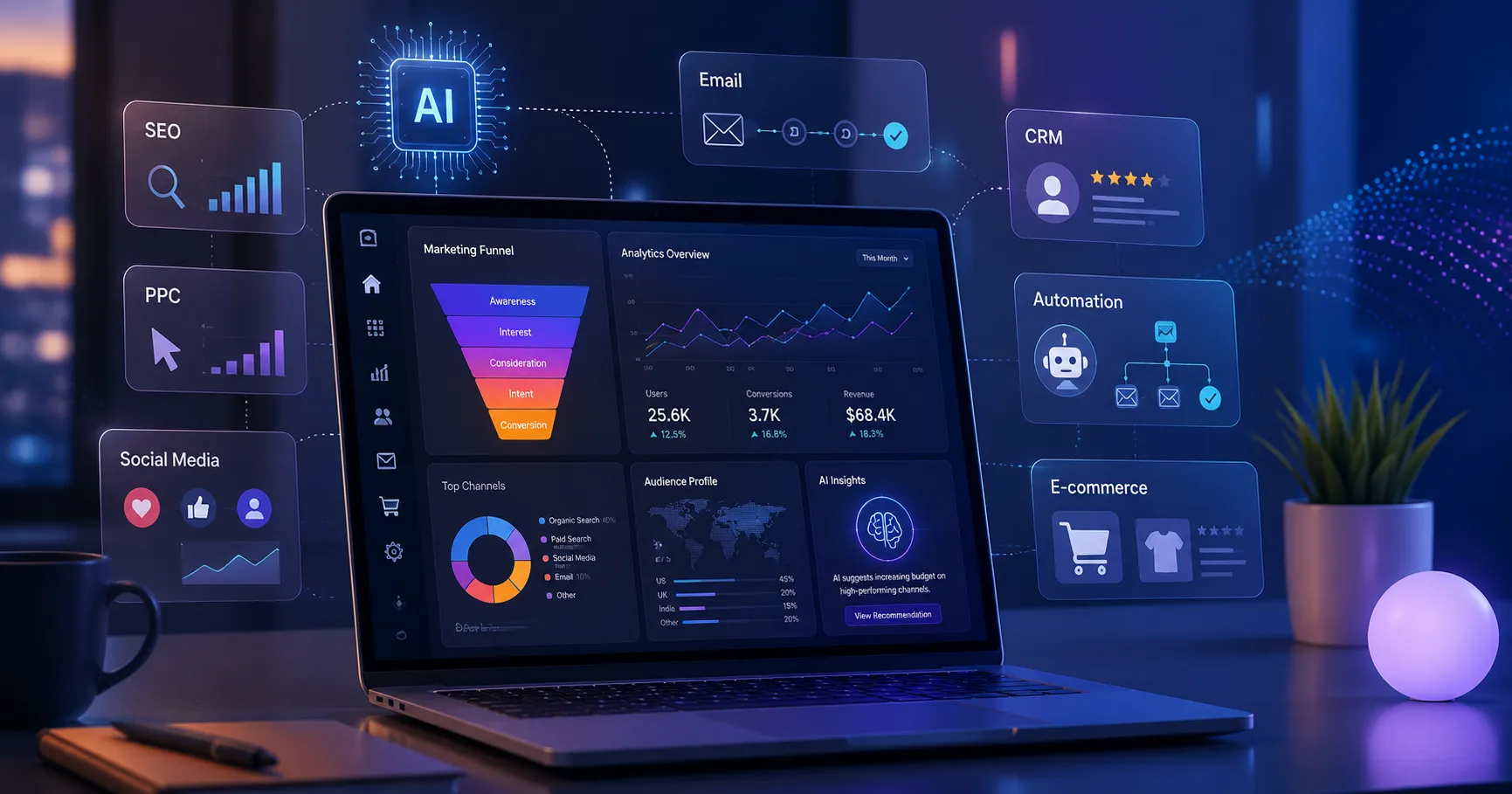
Digital marketing in 2026 is not the same field it was ten or even five years ago. Google Ads has changed. SEO is changing. AI is becoming part of almost every marketing workflow. Customer relationship management, email, SMS, automation, social advertising, analytics, and e-commerce all overlap much more than they used to.
At the same time, the traditional four-year university path does not necessarily make sense for everyone.
There is absolutely value in a university education, and there are careers where a degree is essential. But if the immediate goal is to become productive in digital marketing, there is another path worth considering.
Learn the fundamentals.
Earn respected industry certifications.
Use the actual platforms.
Build real campaigns.
Measure real results.
Develop a portfolio while doing it.
After talking it through, I decided to map out the learning path I would recommend today.
1. Start With the Big Picture
Before specializing in Google Ads, SEO, social media, or anything else, it helps to understand how the pieces fit together.
My first recommendation would be the Google Digital Marketing & E-commerce Professional Certificate.
Google designed the program for beginners, with no previous professional experience required. It covers areas including digital marketing strategy, search, social media, email marketing, analytics, e-commerce, Google Ads, Google Analytics, customer engagement, and online stores.
That makes it a good starting point because it provides context for everything that comes later.
It is not about becoming an expert in every one of those subjects. It is about understanding the ecosystem.
A modern marketer needs to understand how someone can discover a company through Google, encounter it again on social media, visit a landing page, join an email list, enter a CRM, receive an automated follow-up, make a purchase, and later become a repeat customer.
Those are not separate worlds anymore.
2. Learn AI at the Beginning, Not the End
I would also introduce AI very early in the process.
Not because somebody needs to become an “AI marketer.”
AI is quickly becoming part of marketing itself.
A marketer today can use AI to help with:
- Market research
- Competitive research
- Audience development
- Keyword research
- Content planning
- Ad variations
- Email development
- Campaign analysis
- Reporting
- Brainstorming
- Creative concepts
- A/B testing ideas
The important skill is not simply learning how to ask ChatGPT or Gemini a question.
It is learning how to incorporate AI into a professional workflow while still applying human judgment, fact checking, privacy awareness, brand standards, and common sense.
A good short starting point is Google AI Essentials.
3. Go Deep on Google Search Advertising
Once the general foundation is there, I would start specializing.
The first area would be Google Ads Search.
Search advertising teaches one of the most fundamental ideas in digital marketing: getting in front of somebody at the moment they are actively looking for something.
A solid Google Ads foundation should include:
- Search intent
- Keyword strategy
- Negative keywords
- Campaign structure
- Bidding
- Ad copy
- Landing pages
- Conversion goals
- Budget management
- Campaign optimization
The important part is not simply knowing where the buttons are inside Google Ads.
That is a business skill.
I would start with the Google Ads Search Certification.
4. Learn Analytics and Measurement Immediately
Advertising without measurement is guessing.
That is why I would pair Google Ads training with Google Analytics and Google’s Ads Measurement Certification.
A marketer should eventually be comfortable talking about:
- Traffic sources
- Users and sessions
- Events
- Conversions
- Attribution
- Cost per click
- Cost per lead
- Cost per acquisition
- Conversion rate
- Revenue
- Return on ad spend
- Customer lifetime value
The goal is to be able to answer three questions:
What happened?
Why did it happen?
What should we do next?
That ability becomes enormously valuable.
5. Add Meta and Paid Social
Google Search captures existing intent.
Social advertising works differently.
Platforms such as Facebook and Instagram allow marketers to reach audiences who may not currently be searching for the product at all.
That is why I would make Meta the next major platform.
The Meta Social Media Marketing Professional Certificate provides a structured introduction to social strategy, content, Meta Ads Manager, campaign measurement, and paid social advertising.
The current program also includes generative AI and prepares learners for Meta’s Digital Marketing Associate Certification.
I would pursue both:
- Meta Social Media Marketing Professional Certificate
- Meta Digital Marketing Associate Certification
At this point, somebody beginning the learning path should have exposure to two of the most important advertising ecosystems in digital marketing: Google and Meta.
6. Understand CRM, Not Just Advertising
One of the biggest mistakes in learning digital marketing is concentrating entirely on traffic acquisition.
Getting someone to click an advertisement is often only the beginning.
Consider a simple customer journey:
This is where CRM becomes important.
A marketer should understand concepts such as:
- Contacts
- Leads
- Customers
- Companies
- Deals
- Pipelines
- Lifecycle stages
- Segmentation
- Lead sources
- Campaign attribution
- Follow-up
- Reporting and automation
For this part of the learning path, I would spend some time with both HubSpot and Salesforce.
HubSpot Academy
HubSpot is especially useful from a marketing perspective because its training connects CRM concepts with inbound marketing, content, email, lead generation, SEO, social media, and reporting.
HubSpot Academy offers free online training and certifications across marketing, sales, CRM, customer service, content, and related disciplines.
I would particularly look at training around:
- Email marketing
- Content marketing
- CRM
- Lead generation
- Inbound marketing
- Reporting
Salesforce Trailhead
Salesforce is worth learning for a different reason.
It provides exposure to enterprise CRM concepts and terminology.
Salesforce Trailhead offers structured training covering CRM basics, accounts and contacts, leads and opportunities, reporting, dashboards, and broader Salesforce concepts.
The objective at this stage is not necessarily to become a Salesforce administrator.
It is to understand what a serious CRM looks like and how customer data moves through an organization.
Other CRM Platforms
HubSpot and Salesforce are not the only choices.
Smaller businesses may use platforms such as:
- SendPulse
- Zoho
- ActiveCampaign
- Klaviyo
- Mailchimp
- Other industry-specific systems
That is fine.
7. Learn Email, SMS, and Marketing Automation
Once CRM fundamentals make sense, marketing automation becomes much easier to understand.
A modern marketer should know how to build customer journeys involving:
- Welcome sequences
- Lead nurturing
- Segmentation
- Personalized email
- SMS
- Trigger-based communication
- Delays and conditions
- Abandoned cart messages
- Post-purchase follow-up
- Re-engagement
- Unsubscribe management
- Transactional messaging
For example:
New lead
↓
Welcome email
↓
Wait two days
↓
Educational content
↓
Product offer
↓
Customer purchases
↓
Stop prospect sequence
↓
Start customer sequence
Learning how to think in these flows is more important than memorizing a single automation platform.
8. Use a Real E-commerce Business as the Laboratory
At some point, coursework needs to give way to actual work.
This is where an e-commerce business can become an ideal learning environment.
Work on real things:
- Product positioning
- Landing pages
- Product descriptions
- Offers
- Bundles
- Discounts
- Upsells
- Cross-sells
- Customer reviews
- Cart abandonment
- Remarketing
- Email capture
- Conversion optimization
- Repeat purchases
Start with controlled budgets.
Run tests.
Measure the results.
Make another decision.
Repeat.
9. Learn SEO for the AI Era
SEO still matters.
But SEO in 2026 needs to be taught differently.
The traditional fundamentals remain important:
- Search intent
- Keyword research
- On-page optimization
- Internal linking
- Technical SEO
- Structured data
- Backlinks
- Site authority
- Page performance
- Google Search Console
- Local SEO
But search itself is changing.
Customers increasingly discover businesses and information through AI-powered search experiences and answer engines as well as traditional search results.
That means modern marketers should also pay attention to:
- Brand authority
- Entity recognition
- Original research
- Expert content
- Clear information architecture
- Structured information
- Trust signals
- Brand mentions and citations
- Content that is useful enough to be referenced by AI systems
Semrush Academy is one place I would consider for structured SEO training beyond the Google foundation.
10. Learn Enough Technology to Be Dangerous
A digital marketer does not need to become a software engineer.
But technical literacy is an enormous advantage.
At minimum, I would learn the basics of:
- HTML
- CSS
- JavaScript concepts
- Domains
- DNS
- Cookies
- Tracking pixels
- UTM parameters
- Google Tag Manager
- Conversion tracking
- APIs
- Webhooks and JSON concepts
The goal is not to write the application.
The goal is to understand what the developers are talking about, understand how data moves between systems, and be able to configure common marketing technology without being completely dependent on engineering.
11. Build the LinkedIn Profile While Building the Career
This part is easy to overlook.
I would start building a professional LinkedIn presence at the beginning of the learning path, not after it.
As each meaningful credential is earned, add it.
As real projects are completed, document them.
As real work begins, add the position.
Certificates are useful, but a profile containing nothing except certificates is not particularly compelling.
Whenever possible, show what was actually done.
Instead of simply listing:
Google Ads Certified
Eventually, the stronger story is:
Built and managed a paid search campaign, measured acquisition cost and conversions, identified the highest-performing keyword group, and adjusted budget based on actual results.
That shows application rather than simply education.
The same principle applies to a portfolio.
12. Add Project Management Later
I also like the Google Project Management Professional Certificate, but I would not put it near the beginning of this curriculum.
First, learn marketing.
Then participate in some marketing projects.
Once there are real projects to manage, topics such as scope, estimates, budgets, stakeholders, risk, Agile, Scrum, timelines, and communication become much more meaningful.
The Certification Order I Would Use
If I were starting from scratch today, my rough priority would look like this:
- Google Digital Marketing & E-commerce Professional Certificate
- Google AI Essentials
- Google Ads Search Certification
- Google Analytics training
- Google Ads Measurement Certification
- Meta Social Media Marketing Professional Certificate
- Meta Digital Marketing Associate Certification
- HubSpot Digital Marketing Certification
- Salesforce CRM Fundamentals
- Email marketing and marketing automation training
- SEO training
- Google Display, Video, and Shopping certifications as needed
- Google Project Management Professional Certificate later
That is not a collection that needs to be finished before doing any real work.
Quite the opposite.
Google, Microsoft, or University?
This was actually one of the questions that started the original conversation.
If the objective is specifically digital marketing, I would put Google first.
Google is directly connected to search, paid search, analytics, measurement, YouTube, e-commerce, and the broader search ecosystem.
For social advertising, I would put Meta alongside Google.
For CRM and customer lifecycle marketing, HubSpot and Salesforce both provide useful knowledge from different angles.
Microsoft Advertising is absolutely worth understanding eventually, but I would not make Microsoft certifications the foundation of this particular learning path.
And what about university?
There is nothing wrong with pursuing a marketing degree.
For someone who wants the university experience, needs a degree for a particular career path, or wants a deeper academic background in business and marketing theory, it can be a good choice.
But it is no longer the only way to learn this profession.
For someone whose immediate objective is:
I would personally start with industry training and practical experience.
A year spent learning Google, Meta, CRM, analytics, automation, SEO, AI, e-commerce, and technical marketing while simultaneously working on real campaigns could produce an exceptionally strong foundation.
Certificates Get Attention. Experience Gets Work.
This is probably the most important point in the entire roadmap.
Do not spend a year simply collecting badges.
Build things.
Run campaigns.
Make mistakes.
Measure what happened.
Fix them.
Keep track of the results.
Turn successful work into case studies.
The goal is to eventually be able to say:
I built the campaign, defined the audience, created the conversion tracking, spent the budget, measured the acquisition cost, identified what worked, changed what did not, and improved the next campaign.
That is a very different statement from:
I took a digital marketing course.
The certifications can help open the door.
The experience is what makes someone a digital marketer.
How Long Should This Take?
With focused effort, I think six to twelve months is a reasonable timeframe for someone to develop a very credible foundation.
That does not mean becoming an expert in every discipline.
Digital marketing is too broad for that.
The goal is to become comfortable across:
- Paid search
- Paid social
- Analytics
- SEO
- AI
- E-commerce
- CRM
- SMS
- Marketing automation
- Conversion optimization
- Technical marketing
Then specialize based on aptitude, interest, and the type of work that becomes available.