What if the entire lifecycle of a professional website, from initial discovery and planning to development, deployment, email integration, and search indexing, could happen in a single working day?
That was the experiment behind the new Herron Aerials Drone Services website.

The goal wasn’t to see how quickly AI could generate a website. It was to see what happens when AI is integrated thoughtfully across the entire project workflow: before the first client meeting, throughout discovery and planning, during requirements gathering, through development and refinement, and finally into production.
By the end of the day, we had our answer: a polished, production-ready website running on a modern serverless architecture, with lead capture, transactional email, SSL, analytics, and search infrastructure, all deployed and ready for business.
And we started the morning without a finished scope of work.
It Started With a Conversation
Before development began, we used AI to help prepare a focused agenda for a discovery and planning meeting with the client.
The meeting itself took place over Google Meet, with AI-assisted note-taking capturing the discussion. Instead of relying on handwritten notes, memory, and a lengthy requirements process afterward, we came away with a detailed record of what had actually been discussed.
Those meeting notes became the raw material for the next stage.
Working with Shelby in ChatGPT, we reviewed the discussion, identified requirements and decisions, organized the information, and transformed what had been a conversation into a structured project scope.
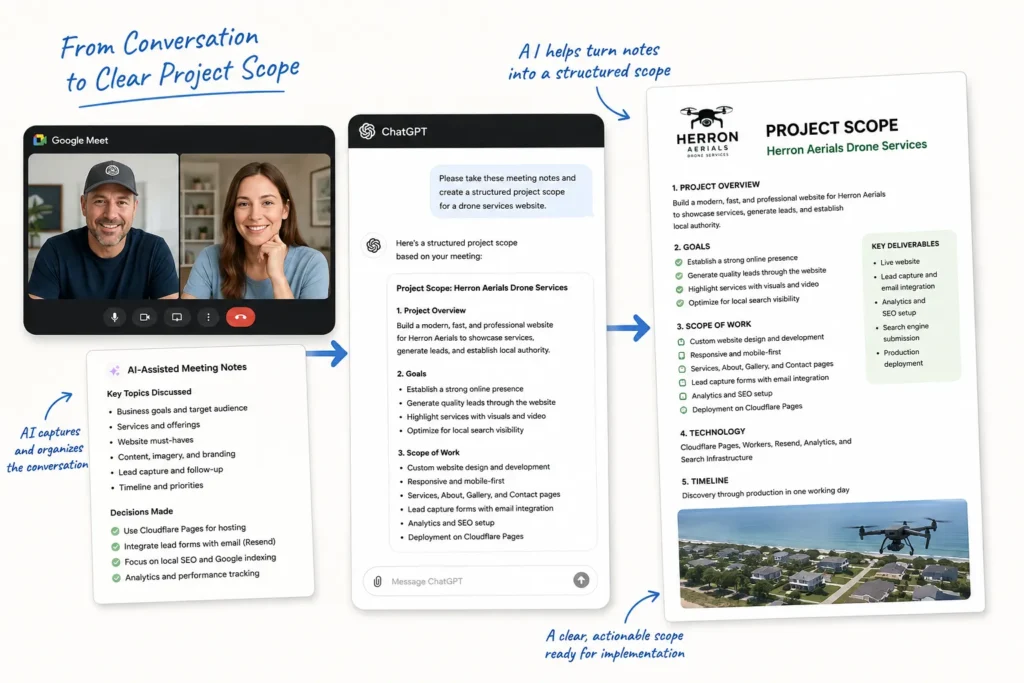
AI didn’t replace the discovery process. It helped us preserve, organize, and act on it.
Turning the Scope Into Build Instructions
Once we understood the project, the next step wasn’t to ask an AI coding tool to simply “build a drone website.”
We did almost the opposite.
We invested heavily in the instructions first.
The discovery material and formal work scope were translated into an unusually detailed implementation prompt for Codex. It described not only what the website should communicate and how it should function, but also how it should be structured, the technologies it should use, the integrations it needed, and the expectations for the finished product.
The prompt was detailed enough that Codex spent nearly 40 minutes on the initial build.
That might sound like a long time for an AI coding agent.
It wasn’t.
Those 40 minutes replaced a significant portion of what would traditionally have been hours, or even days, of initial development. More importantly, the first result wasn’t a disposable prototype. It was a clean, usable foundation that accurately reflected the planning that preceded it.
A few iterations later, we were no longer building the site.
We were finishing it.
Building While the Requirements Were Arriving
There was another wrinkle: we didn’t actually have all of the final content when development started.
The client was still gathering the specific photographs, videos, service information, and other materials we’d identified during discovery.
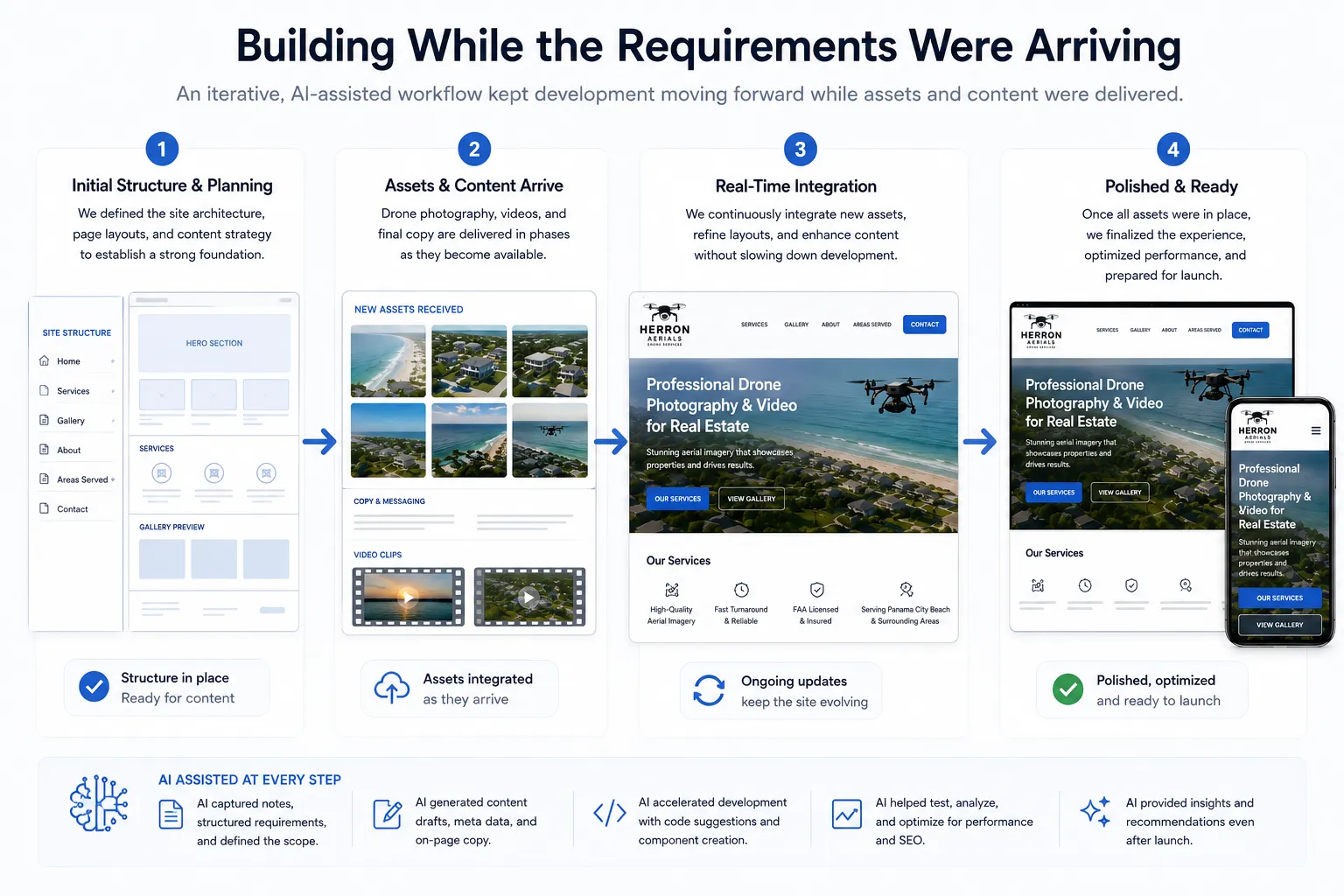
Instead of treating that as a blocker, we built the site’s structure around the decisions we had already made. As the real assets and final details arrived throughout the day, they were incorporated into the working site in real time.
The workflow became continuous
Discovery → Organization → Implementation → Incoming Requirements → Refinement
There wasn’t a long handoff between each phase. The context carried forward from one step to the next, with AI helping turn new information into implementation decisions almost immediately.
AI Wasn’t One Tool in the Workflow. It Connected the Workflow.
That’s probably the most important lesson from the project.
There was no single “AI step.”
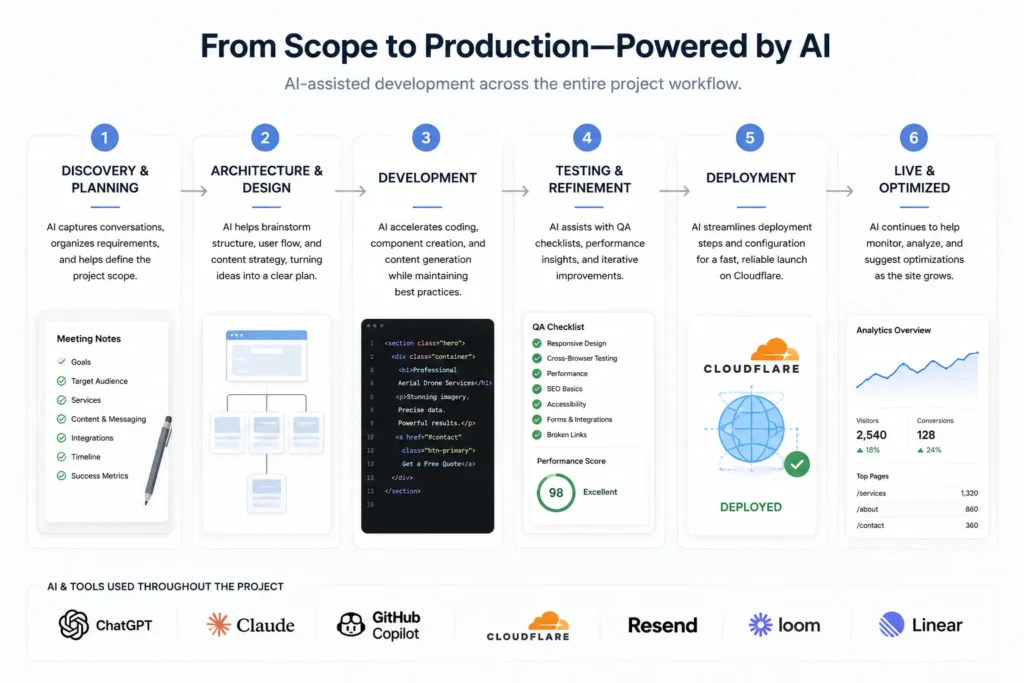
AI helped prepare the meeting. AI captured and summarized the discussion. AI helped turn that discussion into an actionable work scope. That scope became the foundation for detailed development instructions. Codex executed those instructions, and subsequent iterations handled the refinements and integrations required to finish the project.
Human judgment remained at the center of the process, particularly during discovery, design decisions, requirements gathering, review, and approval.
AI dramatically reduced the friction between those decisions and their execution.
That’s where much of the time disappeared.
A Modern Architecture Without a Traditional Hosting Bill
Speed wasn’t the only interesting outcome.
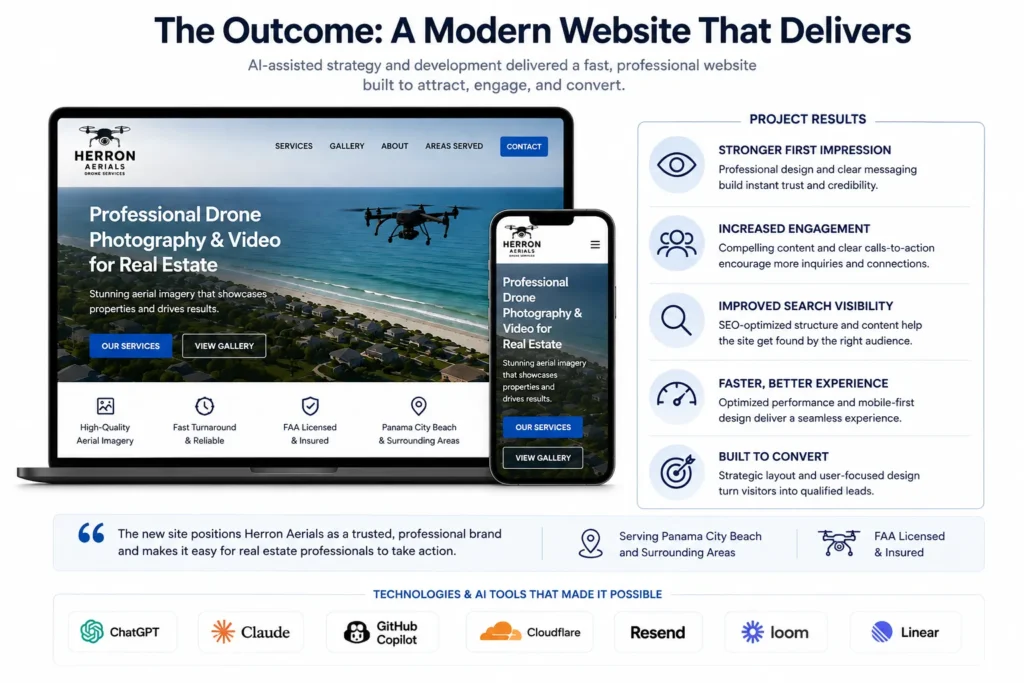
The finished website was deployed using Cloudflare Pages and Workers, giving the project a modern serverless architecture without the traditional burden of maintaining a web server.
SSL is handled automatically. There’s no server operating system to patch, no conventional hosting environment to maintain, and the infrastructure can scale far beyond the needs of a typical small-business website.
Lead-generation forms were wired through Resend for email delivery, completing the path from visitor inquiry to the client’s inbox without requiring a traditional backend application server.
For the project’s current requirements, the infrastructure operates within the providers’ free usage tiers. That gives the client a professionally deployed production website with effectively zero ongoing hosting cost.
That’s a remarkably different operating model from the websites we were building even a few years ago.
One Working Day
By the end of a single working day, we had moved through the lifecycle of an entire web project:
- Discovery and planning
- AI-assisted meeting capture and organization
- Formal project scoping
- Architecture and technology decisions
- Front-end development
- Client content integration
- Lead-capture and email integration
- Testing and refinement
- Production deployment
- SSL and serverless infrastructure
- Search-engine submission and indexing setup
There was even time for lunch.
That’s worth mentioning because the objective wasn’t an eight-hour coding marathon. This was a normal working day in which planning, client communication, development, review, and deployment all happened as parts of the same continuous process.
A project like this could traditionally occupy the better part of a week, not necessarily because every individual task requires that much labor, but because projects lose enormous amounts of time between tasks.
Notes have to become requirements. Requirements have to become specifications. Specifications have to become development tasks. Development has to be reviewed. Changes have to be communicated, interpreted, implemented, and reviewed again.
AI compressed those transitions.
Speed Was the Result, Not the Strategy
The takeaway from this project isn’t that every website should be built in one day.
Some shouldn’t be.
The more interesting lesson is that good planning and AI-assisted execution reinforce each other.
The quality of the initial Codex build wasn’t an accident. It was downstream of the discovery meeting, the meeting notes, the structured scope, the architectural decisions, and the time invested in creating precise instructions before asking the coding agent to act.
AI didn’t make planning less important.
It made good planning dramatically more valuable.
That’s the workflow we’re interested in exploring at hale.group: combining human conversation, judgment, and experience with AI systems that can preserve context, organize complexity, and execute well-defined decisions at extraordinary speed.
Herron Aerials Drone Services gave us a particularly clear demonstration of what that can look like.
From conversation to production, in one day.
See the Finished Website
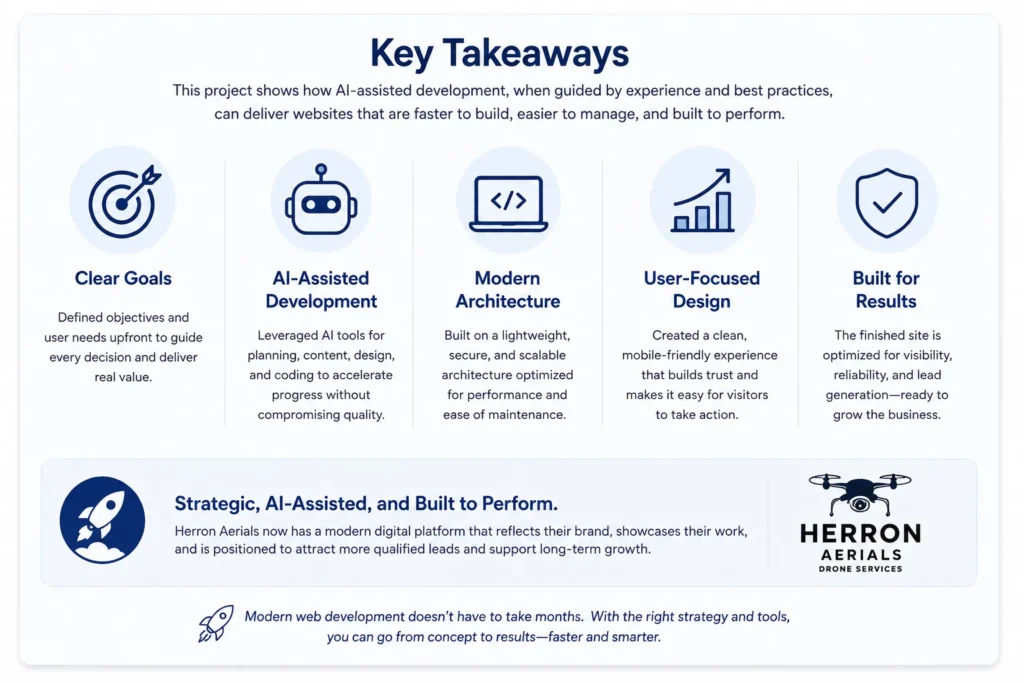
The best way to see where the process ended is to see the finished product. Herron Aerials is now live and serving property owners and clients in the Panama City, Florida area and surrounding communities.
If you’re looking for professional drone photography, aerial video, or property-focused drone services in the area, I encourage you to check out Herron Aerials.
About the Author